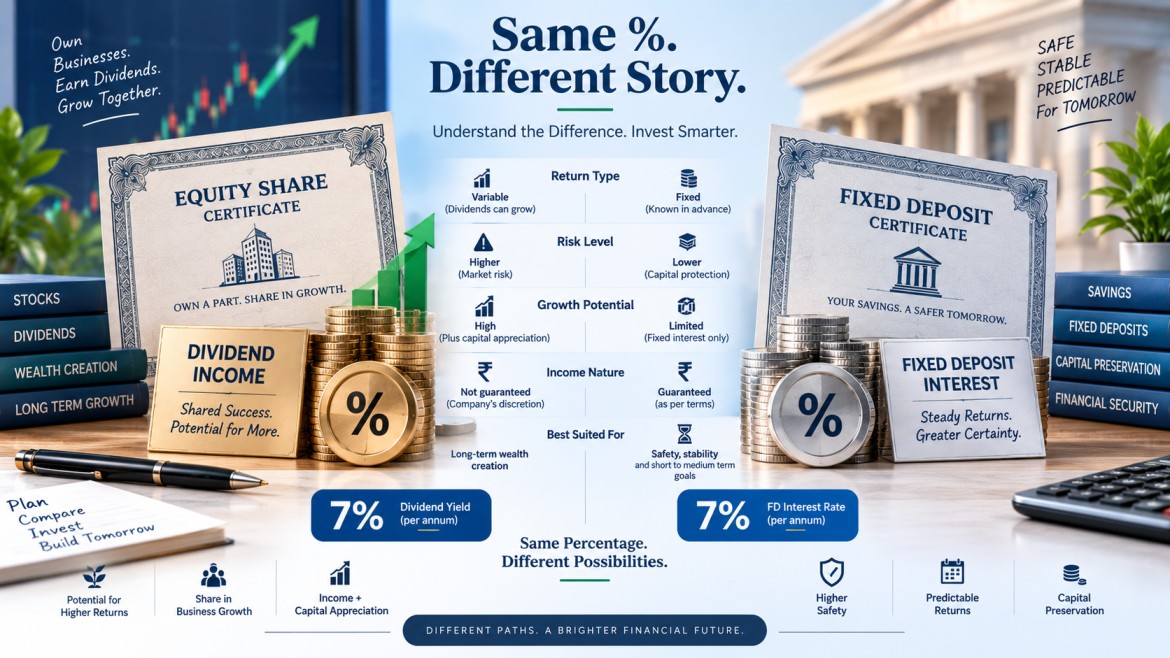
An investor sees one investment offering 8% dividend yield and another offering 8% FD interest.
At first glance, they may appear identical.
They are not.
The percentage alone does not tell you the risk, certainty, taxation, capital appreciation potential or sustainability of the income.
Quick Overview
What Is Dividend Yield?
Dividend yield is generally calculated as:
Annual Dividend per Share ÷ Share Price × 100
Suppose a company pays an annual dividend of:
₹20
and its stock trades at:
₹250
Dividend yield:
₹20 ÷ ₹250 × 100 = 8%
But that 8% is not guaranteed forever.
What Is FD Interest?
An FD provides interest according to the applicable deposit terms.
Suppose you invest:
₹5 lakh
at an annual rate of:
8%
The interest calculation is based on the FD's structure and compounding/payment terms.
The crucial difference is that an FD is a deposit product, while a dividend comes from an equity investment.
The Capital Is Not the Same
Suppose you invest ₹5 lakh in an equity stock because its dividend yield is 8%.
If the stock price falls by 20%, your capital value can decline considerably even if the company continues paying dividends.
An FD does not normally behave in the same market-linked way.
Dividend Is Not Guaranteed
Companies can change their dividend policies.
A business may:
- Increase dividends
- Maintain dividends
- Reduce dividends
- Skip dividends
depending on its financial position and capital requirements.
High Yield Can Be a Warning
Suppose a stock's dividend yield suddenly jumps from 4% to 9%.
You should ask:
Did the dividend increase dramatically?
Or:
Did the share price fall sharply?
A falling stock price can mechanically increase dividend yield.
That does not automatically make the stock attractive.
What About Growth?
An equity investment has another potential return source:
Capital appreciation
If the business grows successfully, the share price may increase.
An FD generally does not provide that kind of equity upside.
So investors are comparing fundamentally different return structures.
Final Takeaway
An 8% FD return and an 8% dividend yield are not equivalent.
One represents interest from a deposit.
The other represents a distribution from an equity investment whose market price can fluctuate.
Always compare:
Income + Capital Risk + Growth Potential + Tax + Liquidity
rather than simply comparing percentages.
FAQs
1. Is dividend yield guaranteed?
No. Future dividends can change.
2. Can a stock with a high dividend yield lose money?
Yes. The share price can fall even when dividends continue.
3. Is FD interest the same as dividend income?
No. They come from fundamentally different financial products.
4. Why can dividend yield suddenly increase?
A decline in the share price can increase the yield calculation even when the dividend itself has not increased.
Disclaimer: This article is for educational purposes and does not recommend any investment product.
Disclaimer: The information provided in this market alert is for educational and informational purposes only and does not constitute financial or investment advice. IPO Chowk aggregates public data; always consult with a SEBI-registered investment advisor before deploying capital.