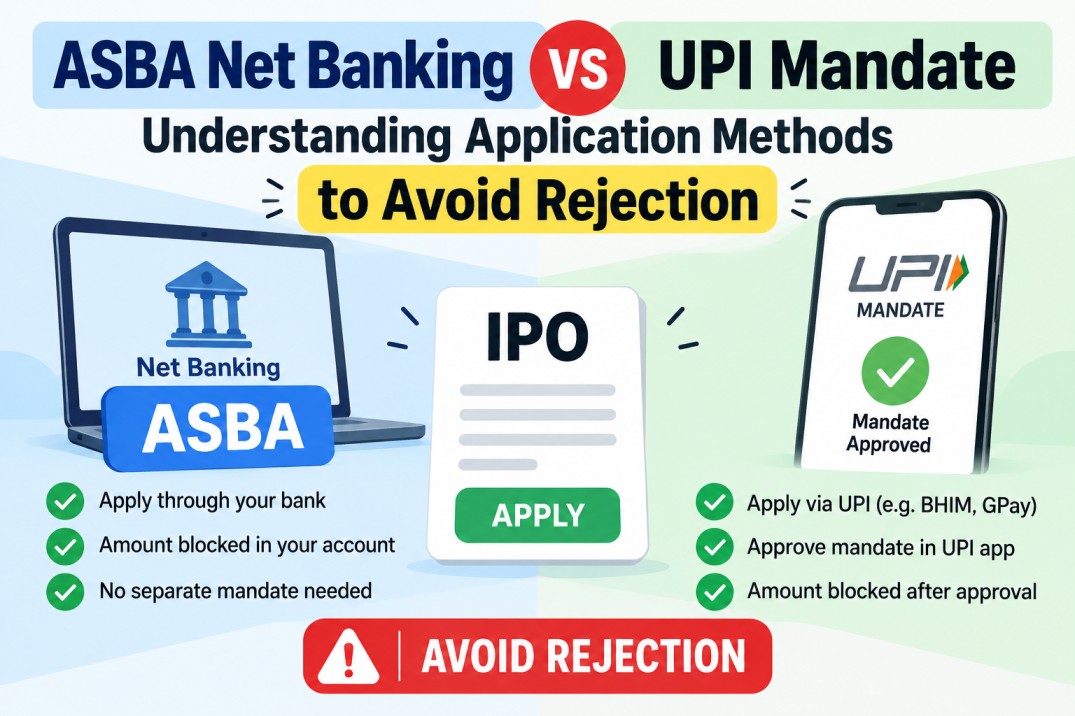
When applying for an IPO in India, retail investors must use one of two payment mechanisms: Application Supported by Blocked Amount (ASBA) via Net Banking or a UPI Payment Mandate through discount brokers. While both prevent upfront deduction of funds, their execution workflows differ significantly.
How the Fund Blocking Mechanism Works
Neither payment method deducts money from your bank account when you apply. Instead, a legal "lien" (hold) is placed on the exact bid amount:
- The blocked funds remain inside your savings account, continuing to earn regular savings interest.
- If you win the allotment lottery, the registrar debits only the value of the allotted shares.
- If you receive no allotment, the lien is unblocked, restoring full liquidity to your balance.
ASBA via Net Banking
In direct ASBA, you log directly into your bank’s internet banking portal (e.g., HDFC, ICICI, SBI, Kotak) and submit your application from the "IPO Services" tab.
- Execution Speed: Instantaneous. The bank verifies your account balance and blocks the funds in real time.
- Application Limits: Supports both retail applications (up to ₹2 Lakh) and High Net-Worth Individual (HNI) applications running into several lakhs or crores.
- Reliability: High. Because it bypasses third-party messaging networks, there is virtually zero risk of authorization lag.
UPI Mandates via Brokers
When applying through broking apps like Zerodha, Groww, AngelOne, or Upstox, you enter your Demat details and submit your UPI ID (VPA).
- Workflow: The stock exchange forwards a mandate request to your UPI application (Google Pay, PhonePe, BHIM). You must approve this request using your UPI PIN before the deadline (usually 5:00 PM on the issue's closing date).
- Transaction Limit: Capped by NPCI/RBI at ₹5 Lakh per IPO transaction.
- Failure Risk: During massive market hype, banking payment gateways face server congestion. Millions of investors experience delayed mandate notifications, leading to missed application windows.
The #1 Cause of Rejection: Third-Party Accounts
Under SEBI mandates, the PAN linked to the Demat account must match the PAN of the bank account used to fund the bid. Submitting an application in your name using your spouse's or friend's UPI ID results in immediate rejection at the registrar validation stage.
Disclaimer: Procedural rules are defined by SEBI and NPCI guidelines. Ensure sufficient account balance and PAN alignment to avoid application cancellations.
Disclaimer: The information provided in this market alert is for educational and informational purposes only and does not constitute financial or investment advice. IPO Chowk aggregates public data; always consult with a SEBI-registered investment advisor before deploying capital.