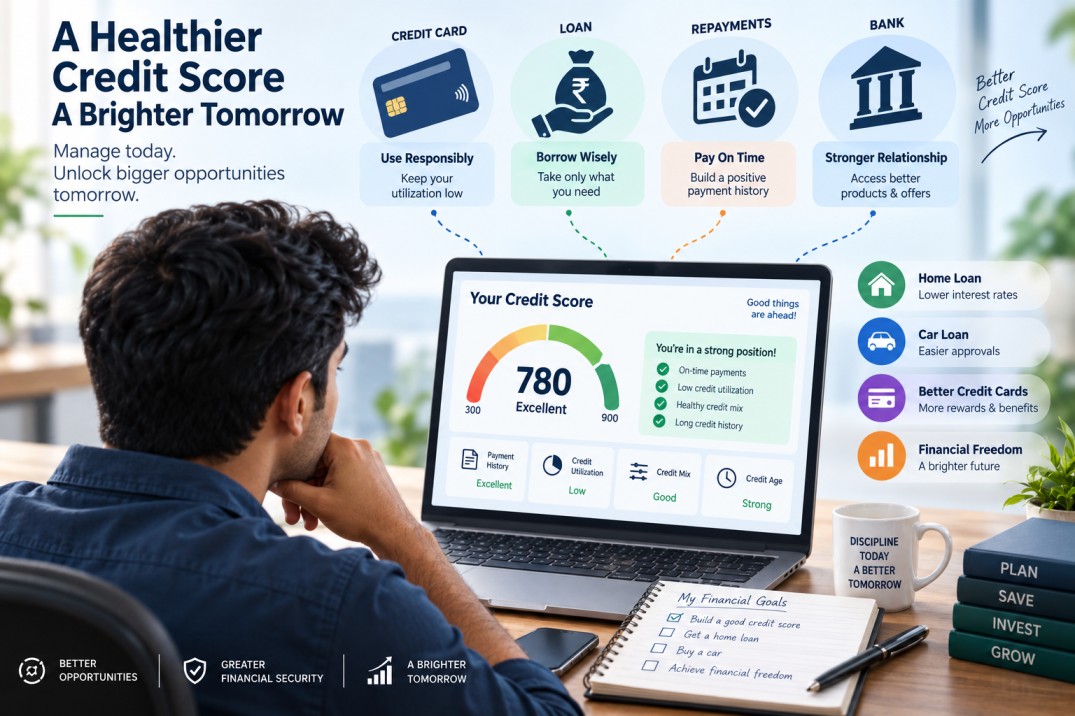
A credit score is more than just a three-digit number.
For lenders, it is one of the tools used to evaluate how a borrower has handled credit in the past. For consumers, a strong credit profile can make borrowing easier and potentially improve access to better loan terms, subject to the lender's own assessment.
Yet many people only think about their credit score when they are preparing to apply for a loan.
That can be a mistake.
Your credit profile is built over time through your borrowing and repayment behaviour. Understanding how it works can help you avoid common mistakes and maintain healthier financial habits.
Quick Overview
What Is a Credit Score?
A credit score is a numerical representation generated from information in a person's credit history.
It is derived from information reported by lenders and other credit institutions to credit bureaus.
The score is designed to help lenders assess credit risk.
A higher score does not guarantee loan approval, and a lower score does not automatically mean a person can never borrow.
The lender also considers other factors such as:
- Income
- Existing obligations
- Employment
- Loan amount
- Loan type
- Internal credit policies
Why Does Repayment History Matter?
One of the most important parts of a credit profile is whether previous credit obligations were repaid according to their terms.
Missing a payment can have consequences that extend beyond a single late fee.
Repeated or serious payment delays can affect the information recorded in a person's credit history.
This is why one of the simplest rules of credit management is:
Borrow carefully and repay on time.
Credit Utilisation Explained
Credit utilisation refers to how much of an available revolving credit limit is being used.
For example:
Credit limit = ₹2,00,000
Outstanding balance = ₹40,000
Utilisation is:
₹40,000 ÷ ₹2,00,000 × 100 = 20%
A consistently high utilisation level can indicate greater dependence on available revolving credit.
That does not mean every individual should target one specific percentage, but keeping utilisation under control is generally a useful credit-management habit.
Does Closing a Credit Card Improve Your Score?
Not necessarily.
Closing a credit card can reduce your total available credit.
Suppose someone has:
If Card B is closed, available credit falls to ₹1,00,000.
If outstanding balances remain the same, overall utilisation can increase.
Therefore, closing an unused card is not automatically a credit-score improvement strategy.
The decision should depend on the card's cost, usefulness and the individual's overall financial situation.
Does Checking Your Own Credit Report Hurt Your Score?
Consumers often worry that checking their own credit information will damage their score.
There is an important distinction between a self-initiated credit check and a lender's credit enquiry conducted as part of a loan or credit application.
Consumers should therefore monitor their own credit reports and look for inaccurate information without assuming that simply reviewing their own report will automatically damage their score.
Why Credit Report Errors Matter
Imagine that a loan is incorrectly shown as unpaid even though the borrower cleared it months ago.
That inaccurate information could create problems when another lender evaluates the person's credit profile.
Potential errors may include:
- Incorrect personal information
- Duplicate accounts
- Incorrect overdue amounts
- Accounts that do not belong to the consumer
- Incorrect payment status
- Loans that were already closed but still appear active
This is why reviewing your credit report periodically is useful.
Practical Ways to Build a Strong Credit Profile
1. Pay on Time
Set reminders or automatic payment arrangements so that instalments and card dues are not missed.
2. Avoid Excessive Borrowing
Credit should support genuine financial needs rather than fund spending that cannot realistically be repaid.
3. Keep Utilisation Under Control
A consistently high credit-card balance relative to the available limit can signal financial pressure.
4. Limit Unnecessary Applications
Applying for multiple loans and cards within a short period can result in multiple lender enquiries.
5. Monitor Your Credit Report
Regularly reviewing the report can help identify errors early.
6. Maintain Long-Term Financial Discipline
A healthy credit profile is built through repeated responsible behaviour, not a single action.
Credit Score vs Credit Report
These terms are often used interchangeably, but they are not identical.
Think of the score as a summary and the report as the underlying record.
What Does Not Automatically Improve Your Score?
There is no single trick that instantly transforms a credit profile.
Buying something on a credit card simply to “increase the score” can be unnecessary.
Taking a loan you do not need solely to create credit history can also be counterproductive.
The strongest approach is usually much simpler:
Use credit responsibly and consistently.
Final Takeaway
A good credit profile is built through ordinary financial discipline.
Paying obligations on time, keeping borrowing under control, avoiding unnecessary applications and checking credit reports for errors can help create healthier long-term credit behaviour.
The important point is to stop thinking about credit health as something that matters only before a loan application.
It is a financial habit that should be managed continuously.
Frequently Asked Questions
Does paying a credit-card bill early help?
Paying on time is the most important part. The exact effect of early payment depends on how the lender reports the account.
Does having several credit cards automatically reduce a credit score?
No. The number of cards by itself does not determine the score. Their balances, repayment behaviour and overall credit profile matter.
Does closing an old loan always improve credit?
Not necessarily. A closed loan can remain part of the person's credit history, and the effect of closing an account depends on the broader credit profile.
Can a person with no credit history have a strong credit score?
A person with very limited credit history may have insufficient information for some scoring models or lenders to assess confidently. Building credit gradually and responsibly can help.
Disclaimer: Credit scoring models and lending policies vary by bureau and lender. This article is educational and should not be treated as a guarantee of credit approval or any particular credit score.
Disclaimer: The information provided in this market alert is for educational and informational purposes only and does not constitute financial or investment advice. IPO Chowk aggregates public data; always consult with a SEBI-registered investment advisor before deploying capital.