Buying or selling a stock is not always as simple as clicking "Buy" or "Sell."
The type of order you place determines important details about price execution and conditions.
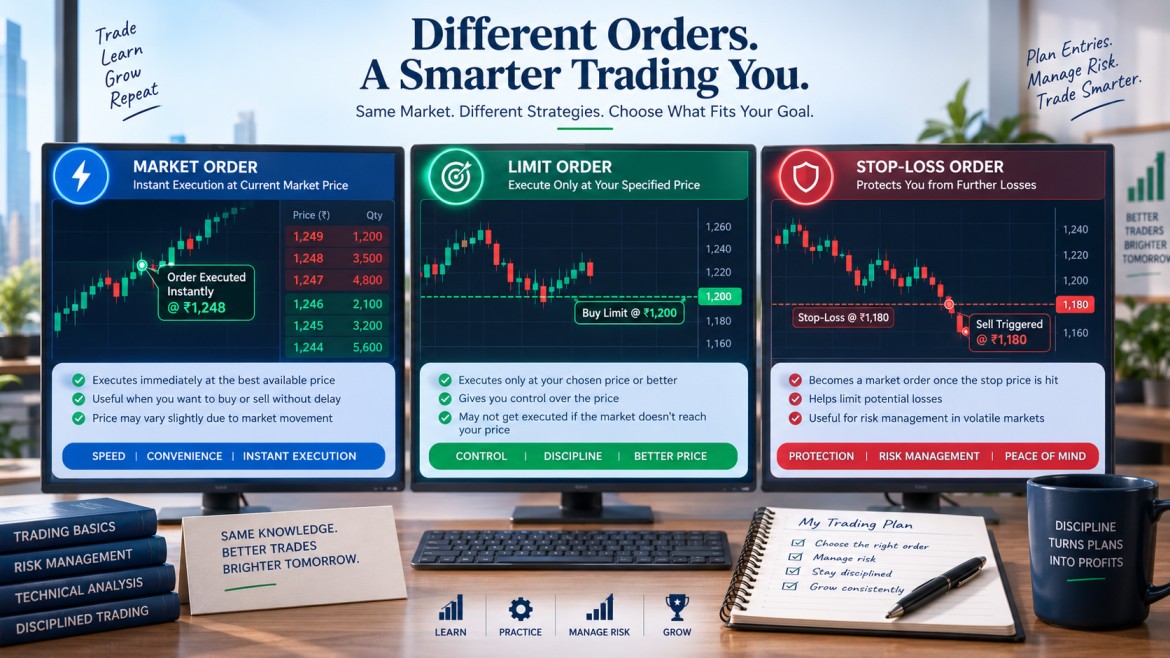
Three commonly discussed order types are Market Order, Limit Order and Stop-Loss Order.
Quick Overview
What Is a Market Order?
A market order tells the exchange to execute the order at the best available price.
The key advantage is:
Higher priority for execution
But the exact execution price may differ from what you expected, particularly in volatile or illiquid stocks.
Example
Suppose a stock is currently trading around:
₹500
You place a market buy order.
You may receive execution around ₹500, but the final price can vary depending on available sellers and market movement.
What Is a Limit Order?
A limit order lets you specify the price at which you are willing to buy or sell.
Suppose a stock trades at ₹500 and you want to buy only at ₹490 or lower.
You place a:
Buy Limit = ₹490
If nobody sells at ₹490 or below while the order remains active, it may not execute.
Limit Order's Main Advantage
You get greater control over the execution price.
But there is a trade-off:
Price certainty does not mean execution certainty.
What Is a Stop-Loss?
A stop-loss order is designed to become active when a specified trigger price is reached.
Investors can use stop-loss mechanisms as part of their risk-management process.
Suppose you hold a stock and choose a trigger around:
₹450
If the market reaches the specified trigger level, the order mechanism activates according to its type and applicable rules.
Market Order vs Limit Order
Why Does Liquidity Matter?
In highly liquid stocks, the difference between expected and actual execution price may often be smaller.
In thinly traded securities, even a relatively small order can move through multiple available price levels.
This is why investors should understand bid-ask spreads and market depth.
Final Takeaway
Choosing an order type is really about deciding what matters more:
Do you prioritise getting the trade executed?
Or:
Do you prioritise controlling the price?
Market orders prioritise execution.
Limit orders prioritise price conditions.
Stop-loss orders can help structure risk management.
FAQs
1. Does a market order guarantee the exact displayed price?
No. The final execution price can differ, particularly in rapidly moving or less liquid markets.
2. Does a limit order guarantee execution?
No. The market must reach the specified price and sufficient quantity must be available.
3. What is a stop-loss used for?
It can be used as a risk-management mechanism to trigger an order when a specified level is reached.
4. Which order type is safest?
No order type is inherently "safest." Each solves a different execution problem.
Disclaimer: This article is educational and does not constitute trading advice.
Disclaimer: The information provided in this market alert is for educational and informational purposes only and does not constitute financial or investment advice. IPO Chowk aggregates public data; always consult with a SEBI-registered investment advisor before deploying capital.