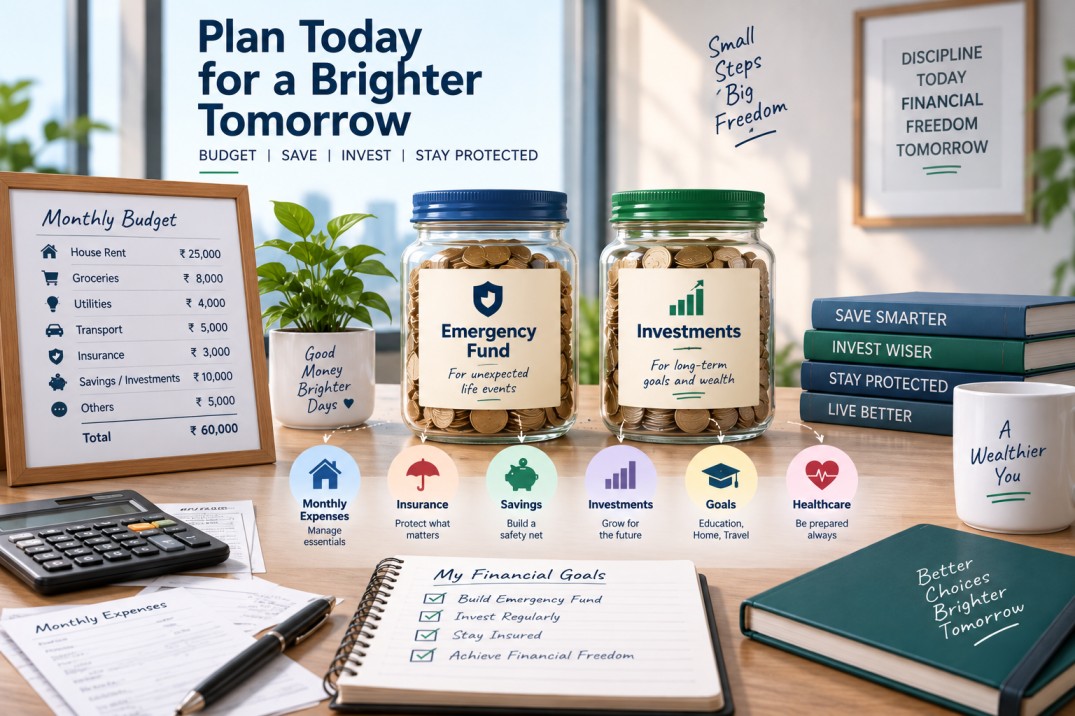
Building wealth is an important financial goal, but investing every available rupee is not always the first step.
Before worrying about whether your portfolio should contain stocks, mutual funds, bonds or other investments, there is a more basic question:
What happens if your income suddenly stops?
An unexpected medical expense, job loss, urgent family requirement or major repair can force a household to sell investments at exactly the wrong time.
This is why an emergency fund plays a different role from an investment portfolio.
The objective of an emergency fund is not to maximise returns.
Its purpose is to provide financial resilience.
Emergency Fund vs Investment Portfolio
What Exactly Is an Emergency Fund?
An emergency fund is money kept aside specifically for unexpected financial needs.
It is not designed for:
- Holidays
- New gadgets
- Dining out
- Planned shopping
- Regular investments
It is intended for genuine financial shocks.
Examples include:
- Loss of employment
- Unexpected medical expenses
- Urgent home repairs
- Major vehicle repairs
- Emergency family obligations
- Other unavoidable expenses
How Much Emergency Fund Do You Need?
There is no universal number that works for everyone.
A practical starting point is to calculate your essential monthly expenses.
Suppose a household spends:
If the household wants six months of essential expenses as a reserve:
₹60,000 × 6 = ₹3,60,000
That does not mean ₹3.60 lakh is mandatory.
It simply demonstrates how the calculation can be approached.
Someone with highly stable employment may approach the target differently from a freelancer, business owner or person with irregular income.
Why Investing Your Emergency Money Can Be Risky
Imagine someone has:
₹3 lakh
and decides to invest the entire amount in a volatile equity portfolio.
Six months later, an emergency occurs.
The portfolio is now worth:
₹2.40 lakh
If the investor needs the full ₹3 lakh immediately, they may have to sell the investments at a loss.
The problem was not necessarily the investment itself.
The problem was using a long-term investment as a substitute for short-term financial reserves.
Emergency Money Should Be Boring
This is one area where boring can be good.
An emergency fund generally benefits from:
Liquidity + Accessibility + Stability
rather than aggressive return chasing.
The exact vehicle depends on the investor's circumstances, but the principle is straightforward:
Money needed during an emergency should not depend heavily on favourable market conditions.
Emergency Fund vs Insurance
These two concepts are also different.
Insurance protects against certain large financial risks.
An emergency fund provides immediately available liquidity.
For example:
Health insurance can help cover eligible medical costs according to policy terms.
But it does not necessarily eliminate every immediate expense.
The emergency fund can cover deductibles, travel, temporary income disruption and other expenses that arise around an emergency.
Insurance and emergency savings therefore complement rather than replace each other.
What If You Have Debt?
Debt changes the calculation.
Someone carrying expensive revolving debt may benefit from reducing that liability while simultaneously establishing a basic emergency reserve.
For example:
Step 1: Build a small initial cash buffer.
Step 2: Aggressively address expensive debt.
Step 3: Expand the emergency fund toward a larger target.
Step 4: Increase long-term investments as cash-flow stability improves.
The exact order depends on the type and cost of debt and the individual's circumstances.
When Should Investments Become the Priority?
Once the financial foundation is reasonably strong, long-term investing can become much more powerful.
For long-term goals, investors may consider diversified assets appropriate to their:
- Risk tolerance
- Time horizon
- Financial goals
- Liquidity needs
The important point is that emergency savings and investments are not competing accounts.
They serve different purposes.
A Simple Three-Bucket Framework
A useful way to think about personal finances is through three buckets.
Bucket 1: Immediate Money
Money for routine spending and near-term obligations.
Bucket 2: Safety Money
Emergency reserves and other highly accessible financial protection.
Bucket 3: Growth Money
Long-term investments designed for future wealth creation.
This framework helps prevent a common mistake:
using growth assets to solve short-term cash-flow problems.
Signs Your Emergency Fund May Be Too Small
You may need to reassess your emergency reserve if:
- A single unexpected bill would require borrowing
- You would need to sell investments immediately after a market fall
- Your income is highly variable
- You support dependents financially
- Your essential monthly expenses are large
- Your job or business income is uncertain
Final Takeaway
The purpose of investing is to build wealth.
The purpose of an emergency fund is to protect your ability to stay financially stable long enough for the rest of your plan to work.
A portfolio can compound for years, but an emergency can arrive tomorrow.
That is why financial planning should not start with:
“What investment will make me the highest return?”
A better first question is:
“How much money do I need to stay financially secure if something goes wrong?”
Once that foundation is in place, investing becomes much easier to approach with patience.
Frequently Asked Questions
How many months of expenses should an emergency fund cover?
There is no universal number. The right amount depends on income stability, dependents, debt, insurance and essential monthly expenses.
Should an emergency fund be invested in stocks?
Money required for emergencies generally should not depend heavily on volatile assets because it may be needed during a market downturn.
Can an emergency fund earn interest?
Yes. The reserve can be kept in suitable liquid and relatively stable instruments according to the individual's requirements.
Should I invest before building an emergency fund?
Some people invest while building their reserve, but the appropriate balance depends on existing savings, debt, income stability and financial goals.
Disclaimer: This article is for educational purposes only. Personal financial requirements vary significantly, and the appropriate emergency-fund strategy depends on each household's circumstances.
Disclaimer: The information provided in this market alert is for educational and informational purposes only and does not constitute financial or investment advice. IPO Chowk aggregates public data; always consult with a SEBI-registered investment advisor before deploying capital.