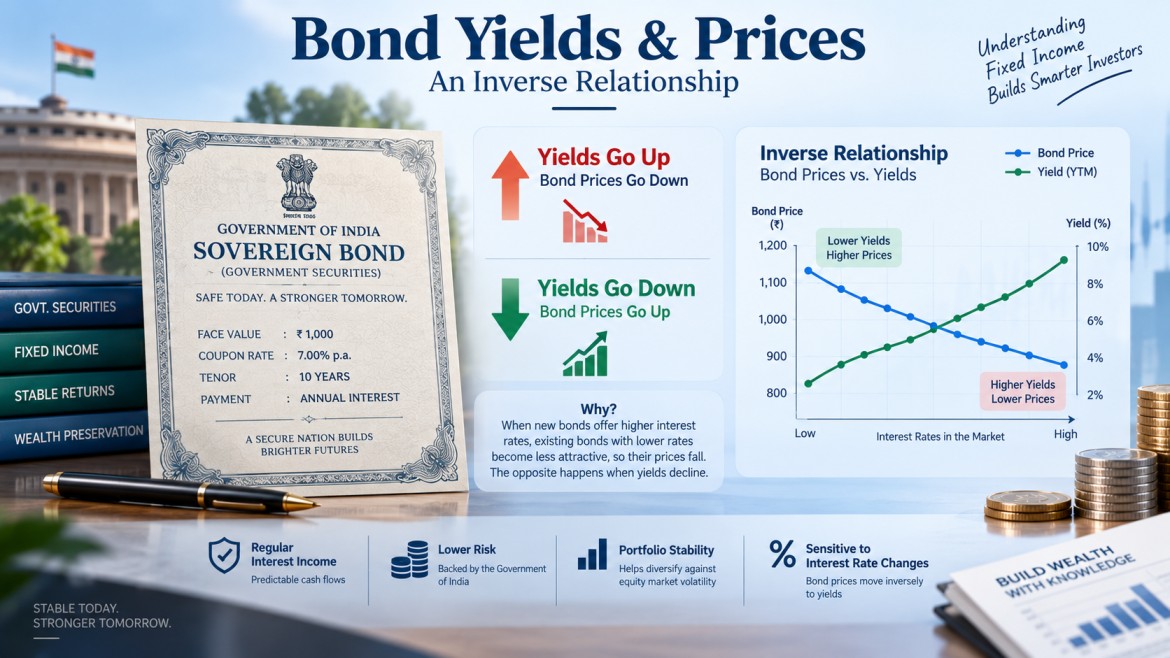
Bond markets can appear complicated because investors frequently hear phrases such as bond yields rising, bond prices falling and interest rates changing.
The underlying relationship becomes much easier to understand once one basic concept is clear:
Bond prices and yields generally move in opposite directions.
Quick Overview
What Is a Bond?
A bond is essentially a form of borrowing.
The issuer may be a government, company or another eligible entity.
The investor provides money and receives payments according to the bond's terms.
What Is a Bond Yield?
Yield is a measure used to express the return associated with a bond.
For market-traded bonds, the yield changes as the market price changes.
That is where the famous inverse relationship comes from.
The Simple Example
Imagine an old bond pays a fixed annual coupon of ₹70.
Suppose its market price is initially:
₹1,000
Now imagine new bonds become available offering better returns.
Investors may be willing to pay less for the old bond.
Suppose its market price falls to:
₹900
The same ₹70 payment now represents a larger return relative to the lower purchase price.
Therefore:
Bond Price ↓ → Yield ↑
And the opposite can happen when market interest rates fall.
Why Do Investors Watch Bond Yields?
Bond yields provide information about:
- Interest-rate expectations
- Inflation expectations
- Government borrowing conditions
- Economic sentiment
- Global capital flows
Bond Yields and Equity Markets
Bond yields can influence equities because investors compare potential returns across asset classes.
When risk-free or relatively lower-risk yields rise significantly, some investors may reassess how much they are willing to pay for equities.
This is particularly relevant for high-valuation stocks whose future cash flows are sensitive to discount rates.
What Causes Yields to Move?
Several factors can influence bond yields:
- Central-bank policy
- Inflation expectations
- Government borrowing
- Economic growth
- Global interest rates
- Demand for bonds
Why Does Inflation Matter?
If investors expect inflation to remain high, they may demand higher yields to compensate for the declining purchasing power of future payments.
Final Takeaway
The bond market becomes much easier to understand once you remember one relationship:
Prices and yields generally move in opposite directions.
That single concept helps explain many movements in fixed-income markets and their relationship with broader financial markets.
FAQs
1. What happens to bond yields when prices rise?
All else equal, yields generally fall when bond prices rise.
2. Why do bond prices fall when interest rates rise?
Existing bonds with lower fixed payments become less attractive compared with newly issued bonds offering higher rates.
3. Why do equity investors track bond yields?
Bond yields can influence valuations, borrowing costs and the relative attractiveness of different asset classes.
4. Are all bonds equally sensitive to interest-rate changes?
No. Sensitivity can vary based on factors such as maturity and bond characteristics.
Disclaimer: This article is educational and does not provide investment or trading recommendations.
Disclaimer: The information provided in this market alert is for educational and informational purposes only and does not constitute financial or investment advice. IPO Chowk aggregates public data; always consult with a SEBI-registered investment advisor before deploying capital.